Why Should Kids Have Homework: 6 Pros and Cons of Homework for Kids and Students
Published on
May 17, 2026
Author
Craig Chou
Project Writer | Craig Chou encourages a holistic approach to fitness and well-being. His dedication to maintaining an open mind and challenging traditional medical literature with insights from contemporary studies sets him apart as a forward-thinking writer. He also studies Eastern medicinal techniques, and tries to bring Western ideas into it, thereby bridging two schools of thought in medicinal approach into one.
Can music and movement help fine motor skills?
Yes—finger plays, clapping games, and dance routines that use hand gestures all help. Combine rhythm and repetition for deeper learning.
How can educators encourage home practice?
Send home simple activity ideas, kits, or worksheets. Offer short instructions and encourage family involvement. Regular practice builds lasting progress.
What crafts are best for fine motor practice?
Try origami, sticker scenes, stringing pasta, or painting with Q-tips. Crafts that use small pieces build precision and control.
Some parents feel that homework helps their children grow and learn. Others worry that it causes too much stress and takes away family time. Students, of course, often just wish it would disappear entirely!
Homework has been a part of school life for generations, from elementary schools all the way through high school. But today's families are rethinking its purpose and asking harder questions: Is it helping? Is there too much homework? Does it really make a difference?
What Is Homework Really For?
To understand the value of homework, it helps to understand what it is actually designed to do. Homework is not just extra busywork sent home to keep kids occupied. When thoughtfully assigned, it serves three important goals:
Reinforcement – Homework helps children review and practice what they learned in class that day.
Independent practice – It gives kids a chance to work through problems on their own, without their teacher standing by.
Preparation – Certain assignments give students an early peek at concepts and ideas that will be covered in future lessons.
Think of it as learning a new sport or hobby. A coach or teacher can walk you through the steps, but real mastery only comes from putting in the practice on your own. Homework serves that exact purpose. It gives children the time and space to work through what they discovered in class, turning short-term lessons into knowledge that truly lasts.
The Science Behind Homework: What Research Says
So does homework actually work? Researchers have been studying whether students benefit from homework for decades, and the short answer is: yes — when it's done right.
1. Repetition builds memory
One of the most important things we know about how the brain learns is this: repetition matters. When a student reads about a topic in class and then practices it again at home, they are strengthening the connections in their brain that hold onto that information. Scientists call this "spaced practice," and it is one of the most effective tools for long-term learning.
For example, if a kid learns their multiplication tables in class but never practices them at home, those facts are likely to fade quickly. But a child who reviews them a little each night is much more likely to remember them weeks or even years later.
2. Moderate homework = better results
Research consistently shows that a moderate amount of homework improves student understanding and academic performance, especially for students in middle and high school. For younger kids in grades 1–3 at elementary schools, the effects are smaller but still positive, mainly because homework at that age helps develop study habits and routines that help students for life.
That said, there is an important line that should never be crossed. Piling on more assignments than a child can reasonably handle can do more harm than good. Leaving kids feeling burnt out, robbing them of sleep, and slowly draining their enthusiasm for school. A homework load that is too heavy to balance with other parts of a child's life can quickly become a source of stress rather than a tool for growth.
That is where the "10-minute rule" proves helpful. A simple principle suggesting that children should spend no more than 10 minutes on homework for every grade level they are in. That means about 10 minutes for a 1st grader, 30 minutes for a 3rd grader, and 60–70 minutes for middle and high school students.
📊 Research Says: Quality over quantity is the golden rule. Focused, purposeful homework for 20–60 minutes is far more effective than hours of repetitive drill sheets.
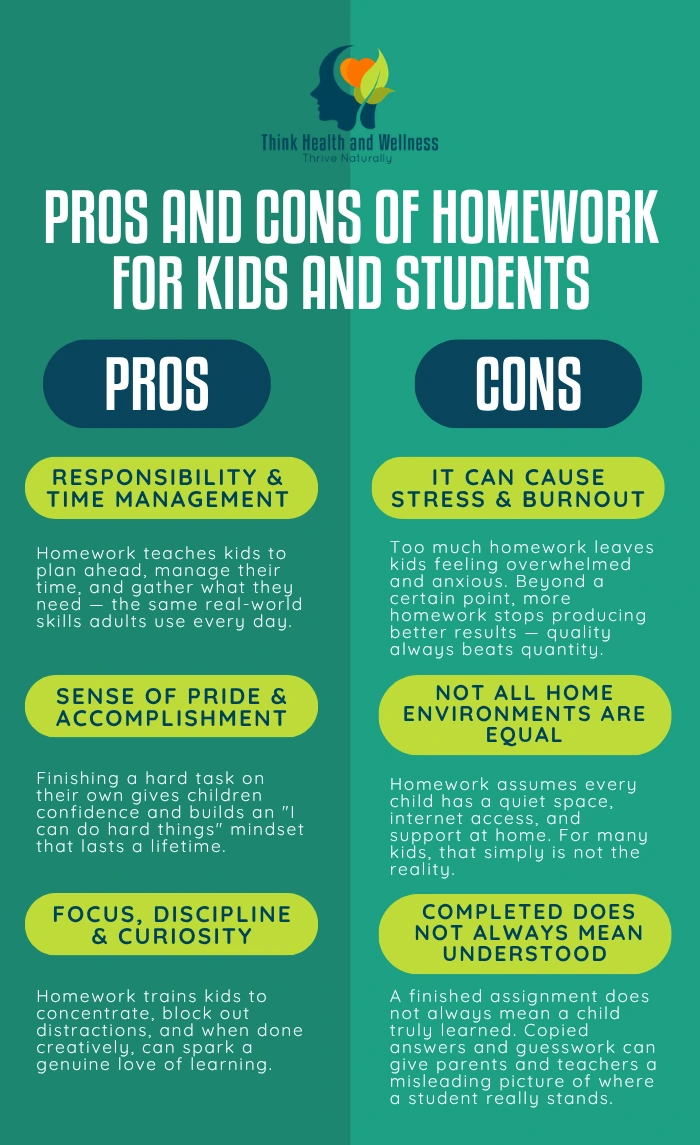
Pros of Homework
One of the most overlooked benefits of homework has nothing to do with test scores or grades. Homework quietly teaches kids some of the most important life skills they will ever need.
1. Responsibility and Time management
When a child has an assignment due the next day, they must decide when to complete homework, how long it will take, and what materials they need. These are real-world planning skills. A kid who learns to manage their time well is practicing the same kind of thinking that adults use to meet deadlines at work, manage household tasks, and plan ahead. Time management, in fact, is one of the greatest long-term benefits that homework helps students develop.
2. A Sense of Pride and Accomplishment
There is something special about finishing a hard task on your own. When a student works through a difficult math problem, writes a paragraph about a book they read, or completes a science worksheet, and does it themselves, they gain a feeling of confidence and pride. Over time, these small wins add up to a bigger belief: "I can do hard things."
This sense of self-reliance is something no grade can fully capture. It builds the kind of inner motivation that helps kids tackle challenges throughout their whole lives.
3. Focus, Discipline, and Curiosity
Homework also teaches children how to sit down, tune out distractions, and focus on a task until it is done. In a world full of screens and interruptions, this ability to concentrate is more valuable than ever. And when homework goes beyond rote memorization — when it asks a kid to observe something in nature, draw a diagram, or read a story they enjoy — it can spark genuine curiosity and a love of learning.
Cons of Homework
While homework can be a powerful learning tool, it is not without its drawbacks, and parents deserve to know about them.
1. It can cause stress and burnout
When the homework load becomes too heavy, kids can feel overwhelmed, anxious, and emotionally drained. Research is clear on this: beyond a certain point, adding more homework does not produce better results. For elementary school students especially, the academic benefit of large amounts of homework is very small. What matters far more is whether the homework is meaningful, well-targeted, and appropriately timed.
2. Not all home environments are equal
Here is a hard truth: homework assumes that every child goes home to a quiet, supportive environment with the resources they need. Sadly, that is not the reality for every child. Some kids share small spaces with many family members. Others lack reliable internet access or do not have a parent available to help. When homework is assigned without considering these differences, it can unintentionally widen the gap between students from different backgrounds rather than help students equally.
3. Completed does not always mean understood
A child can hand in a completed homework assignment without truly understanding it. Whether students copied answers from a sibling, guessed their way through problems, or received too much help, the finished paper does not always reflect real learning. This can give both parents and teachers a false picture of where a student actually stands.
What Does Good Homework Look Like?
Reading Logs – A child reads for 15–20 minutes each night outside of school and records what they read and what they thought about it. This builds vocabulary, comprehension, and a love of books.
Math Practice Games – Instead of a worksheet, a parent and kid play a card game that practices addition or fractions. Learning through play is engaging and effective.
Home Science Experiments – A student observes how a plant grows over the week, keeps a journal, and draws pictures of the changes they see. This connects science to real life.
Drawing to Explain a Concept – After learning about the water cycle or the parts of a cell, a student draws and labels a diagram from memory. Visual learning helps many kids understand and remember more clearly.
Creative Writing Journals – A child writes a short story or reflection on a topic of their choice. This builds writing fluency and allows self-expression.
Notice that none of these examples involve mindlessly copying sentences or filling in endless worksheets. The best homework makes kids think, create, explore, and apply what they know in new ways.
7 Tips for Parents: Supporting Homework Without The Stress
As a parent, you play a huge role in how your child feels about homework. Here are some practical, research-backed tips to help make homework time calmer and more productive:
✔ Set a consistent time and place. Choose a regular homework spot that is quiet, well-lit, and free of distractions like TV or loud noise. Doing homework at the same time each day helps it become a natural habit.
✔ Be available but don't do it for them. Your role is to be a supportive presence, not the one who solves everything for them. Instead of stepping in with the answer, try asking gentle questions that push your child to think it through on their own, because that struggle and self-discovery is precisely where real learning and independence take root.
✔ Divide big tasks into smaller chunks. If your child feels overwhelmed, help them break the homework into manageable pieces. "Let's just start with the first three problems" goes a long way.
✔ Celebrate effort, not just results. Praise your child for trying hard, even when they get something wrong. Building a "growth mindset" — the belief that effort leads to improvement — is one of the greatest gifts you can give.
✔ Communicate with teachers. If your child consistently spends more than the recommended time on homework, or frequently struggles and is in tears, reach out to their educator. Good teachers want to know this feedback and can help adjust the homework load.
✔ Make it fun when possible. For younger kids especially, turning practice into a game or challenge can make homework feel less like a chore.
✔ Protect sleep and family time. No assignment is worth sacrificing a good night's rest or precious time together as a family. If homework is regularly cutting into sleep or family time, that is a problem worth addressing with the school.
Homework, when thoughtfully assigned and supported at home, is much more than just extra schoolwork. It is a daily opportunity for kids to grow, not just as students, but as thinkers, planners, problem-solvers, and self-motivated learners.
Research tells us that a moderate amount of homework helps students remember more, perform better in school, and develop skills they will use for the rest of their lives. The value of homework lies not in how much is assigned, but in how meaningful it is. The key is keeping the homework load balanced, keeping it purposeful, and keeping communication open between parents, students, and educators — from elementary schools all the way through high school.
Homework doesn't have to be a battle. With the right approach, it can be a bridge. A bridge between the classroom and the real world, between what a child knows today and who they will become tomorrow.